
Cultural Enforcement: Difference between revisions
No edit summary |
No edit summary |
||
| Line 1: | Line 1: | ||
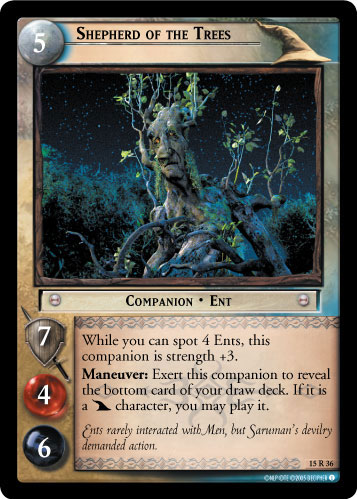
[[File:LOTR-EN15S036.0_card.jpg|right|frame|link=Shepherd_of_the_Trees_(15R36)|''By requiring 4 other Ents to gain the strength bonus, [[Shepherd_of_the_Trees_(15R36)|Shepherd of the Trees]] hammers home that he is only to be used with a very specific sort of deck indeed.'']] | [[File:LOTR-EN15S036.0_card.jpg|right|frame|link=Shepherd_of_the_Trees_(15R36)|''By requiring 4 other Ents to gain the strength bonus, [[Shepherd_of_the_Trees_(15R36)|Shepherd of the Trees]] hammers home that he is only to be used with a very specific sort of deck indeed.'']] | ||
'''Cultural Enforcement''' is the mechanism used throughout the LotR-TCG to, well, enforce the use of specific [[culture]]s (think of it like the use of colored mana costs in Magic: the Gathering). Cards with cultural enforcement require you to play them as part of a deck that focuses on that specific [[culture]] to a greater or lesser degree, depending on the level of | '''Cultural Enforcement''' is the mechanism used throughout the LotR-TCG to, well, enforce the use of specific [[culture]]s (think of it like the use of colored mana costs in Magic: the Gathering). Cards with cultural enforcement require you to play them as part of a deck that focuses on that specific [[culture]] to a greater or lesser degree, depending on the intended power level of the card. Usually this takes the form of [[spot]]ting, [[exert]]ing, or targeting cards of a particular culture, but in some cases this is done more indirectly. | ||
Such indirect methods include: | |||
* Referring to a specific [[Race]] that only appears in one culture ([[Dwarf]] for the {{C|Dwarven}} culture, [[Nazgul]] for {{C|Ringwraith}}). | * Referring to a specific [[Race]] that only appears in one culture ([[Dwarf]] for the {{C|Dwarven}} culture, [[Nazgul]] for {{C|Ringwraith}}). | ||
Revision as of 09:29, 29 December 2021
Cultural Enforcement is the mechanism used throughout the LotR-TCG to, well, enforce the use of specific cultures (think of it like the use of colored mana costs in Magic: the Gathering). Cards with cultural enforcement require you to play them as part of a deck that focuses on that specific culture to a greater or lesser degree, depending on the intended power level of the card. Usually this takes the form of spotting, exerting, or targeting cards of a particular culture, but in some cases this is done more indirectly.
Such indirect methods include:
- Referring to a specific Race that only appears in one culture (Dwarf for the
 Dwarven culture, Nazgul for
  Ringwraith).
 - Referring to unique individuals by name who are only part of one culture (Gandalf for
 Gandalf, Theoden for
  Rohan).
 - Referring to keywords which are exclusive subcultures of a particular culture (besiegers for
 Sauron, Corsairs for
  Raider).
 - Utilizing mechanics which are used primarily by one culture (roaming minions for
 Gondor Rangers, mass archery for the
  Elven culture).
The more cultural requirements, the stronger the enforcement is (and theoretically, the stronger or more thematic the effect you purchase as a result). Denethor, Lord of Minas Tirith (10R28)
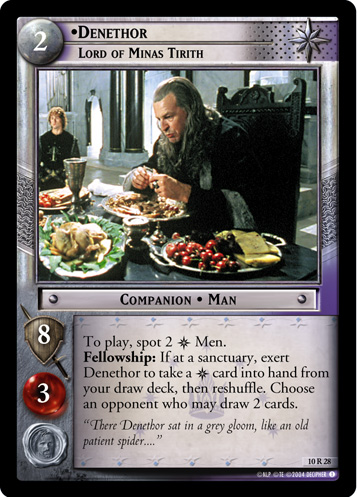 is an example of a card with very strong cultural enforcement since he has to spot two other Gondor Men just to be played, and once on the table his ability doesn't even work except with Gondor culture cards. On the other hand, your investment into that culture purchases you the ability to pull any Gondor cards you want from your deck, which cannot be underestimated.
In contrast, Legolas, Greenleaf (1R50)
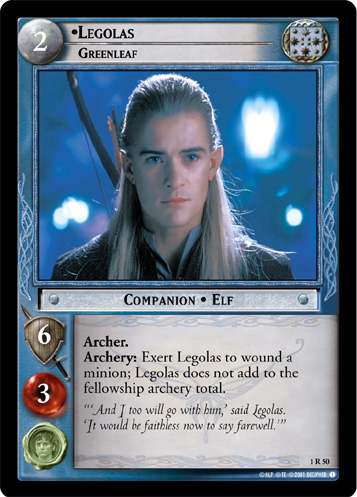 has very weak cultural enforcement, since he does not require any other Elven cards to function (or any other cards at all, for that matter). Cards with such weak cultural enforcement are often splashed into decks focusing on another culture, or used as part of a Rainbow deck.
Cultural enforcement is often layered or stacked, such as with Madril, Loyal Lieutenant (17S30)
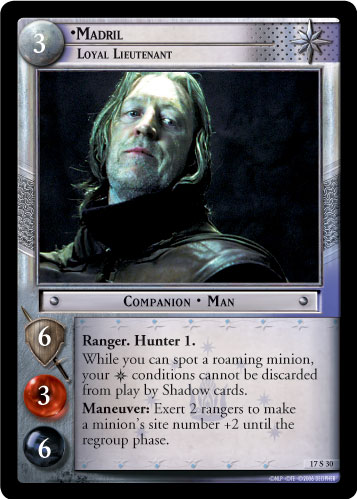 , which not only references the Gondor culture, but also the Ranger keyword (almost exclusive to Gondor) and manipulation of minion site numbers (an exclusively Ranger-y thing to do). There is a very specific sort of deck that Madril was designed for here, and his layers of cultural enforcement hint at what that is. You would do well to pair Madril (or any card for that matter) with similar cards that overlap and push in the same direction, so your deck can be as efficient and synergistic as possible.

