
Bear: Difference between revisions
m (minor stuff) |
(forgot weather and a few other similar cards) |
||
| (One intermediate revision by the same user not shown) | |||
| Line 1: | Line 1: | ||
'''Bear''' is a formal game term. A [[character]] bears the cards played on that character. This usually includes [[possession]] and [[artifact]] cards representing the items that character is wearing or using, as with {{Card|Hobbit Sword}} or {{Card|Mithril-coat}}, but it can also include [[condition]]s representing circumstances that only apply to that character, like {{Card|Desperate Defense of the Ring}} or {{Card|Dwarven Heart}}. | '''Bear''' is a formal game term. A [[character]] bears the cards played on that character. This usually includes [[possession]] and [[artifact]] cards representing the items that character is wearing or using, as with {{Card|Hobbit Sword}} or {{Card|Mithril-coat}}, but it can also include [[condition]]s representing circumstances that only apply to that character, like {{Card|Desperate Defense of the Ring}} or {{Card|Dwarven Heart}}. There are also a handful of conditions, mostly [[weather]] conditions, which are played on a [[site]] rather than a character. | ||
Every player starts the game with the [[Ring-bearer]] bearing [[The One Ring]]. | Every player starts the game with the [[Ring-bearer]] bearing [[The One Ring]]. | ||
Except for characters | Except for characters, cards in play are always borne by a character or site, or else they are in the [[Support Area]]. A card cannot be both borne by a character and in the Support Area; it is either one or the other, although the bearer may be an [[ally]] in the Support Area. If a character is at a particular site, all cards borne by that character are also at that site. Some cards can be transferred from the Support Area to being borne by a character or vice versa, such as {{Card|Blade Tip}} and all [[Follower]]s. | ||
Cards [[stack]]ed on another card, as with {{Card|Goblin Swarms}} or {{Card|Gandalf's Cart}}, are not borne. Those cards are not in play. | Cards [[stack]]ed on another card, as with {{Card|Goblin Swarms}} or {{Card|Gandalf's Cart}}, are not borne. Those stacked cards are not in play. | ||
Not to be confused with {{Card|Grimbeorn}}. | Not to be confused with {{Card|Grimbeorn}}. | ||
Latest revision as of 01:59, 17 March 2022
Bear is a formal game term. A character bears the cards played on that character. This usually includes possession and artifact cards representing the items that character is wearing or using, as with Hobbit Sword (1C299)
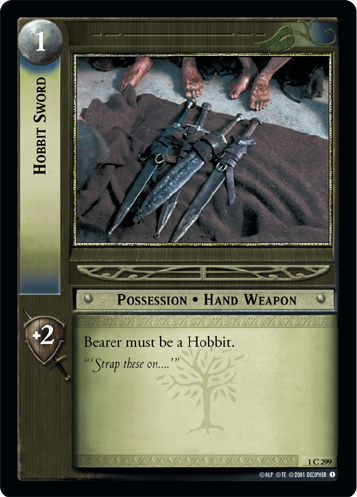 or Mithril-coat (2R105)
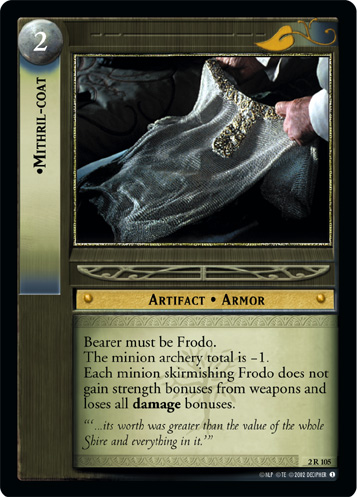 , but it can also include conditions representing circumstances that only apply to that character, like Desperate Defense of the Ring (1R244)
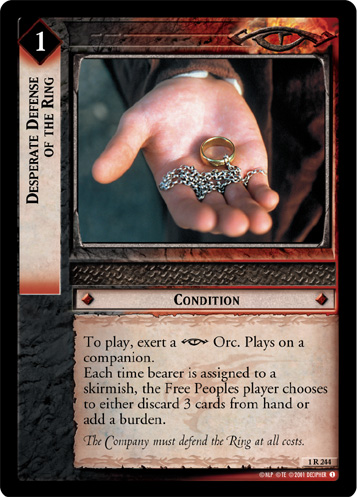 or Dwarven Heart (1C10)
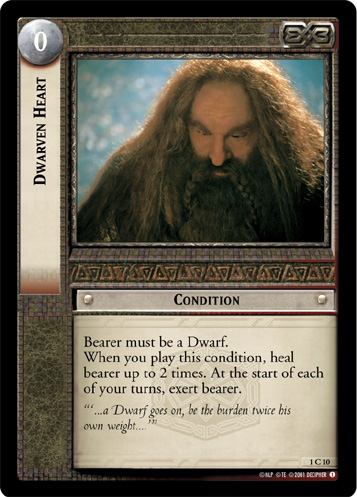 . There are also a handful of conditions, mostly weather conditions, which are played on a site rather than a character.
Every player starts the game with the Ring-bearer bearing The One Ring.
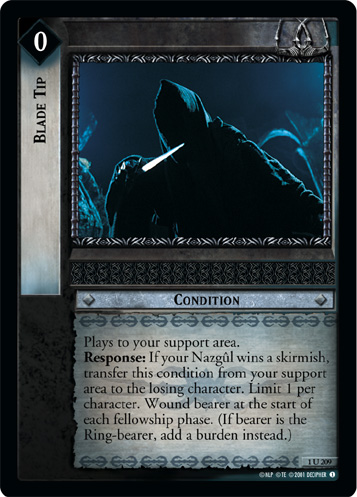
Except for characters, cards in play are always borne by a character or site, or else they are in the Support Area. A card cannot be both borne by a character and in the Support Area; it is either one or the other, although the bearer may be an ally in the Support Area. If a character is at a particular site, all cards borne by that character are also at that site. Some cards can be transferred from the Support Area to being borne by a character or vice versa, such as Blade Tip (1U209)
 and all Followers.
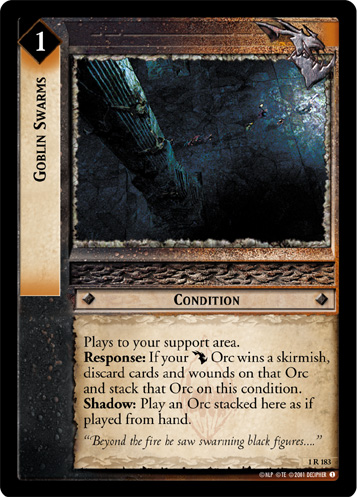
Cards stacked on another card, as with Goblin Swarms (1R183)
 or Gandalf's Cart (1U73)
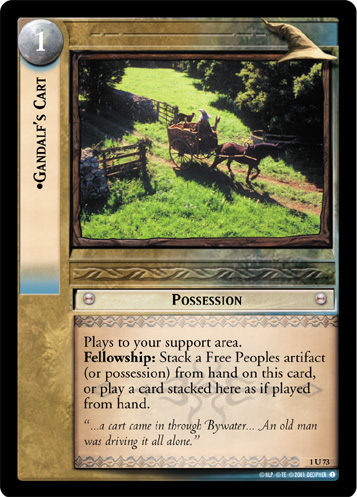 , are not borne. Those stacked cards are not in play.
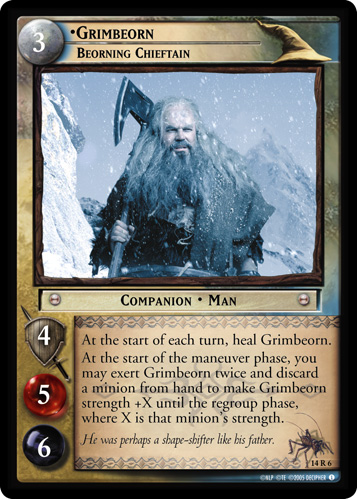
Not to be confused with Grimbeorn, Beorning Chieftain (14R6)
 .
.

