
Stack
Stacking is a formal game term. Some cards, like Gandalf's Cart (1U73)
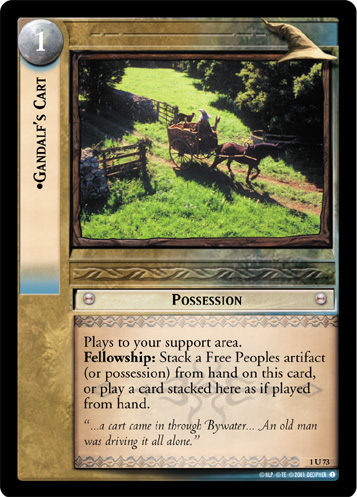 , stack other cards on themselves, for later use or for some sort of benefit. Stacked cards are not in play and thus cannot be spotted, but they also are not in a Discard Pile or Hand. They cannot be played or affected in any way unless a special ability specifically says so. Usually this is the card they are stacked on, as with Goblin Swarms (1R183)
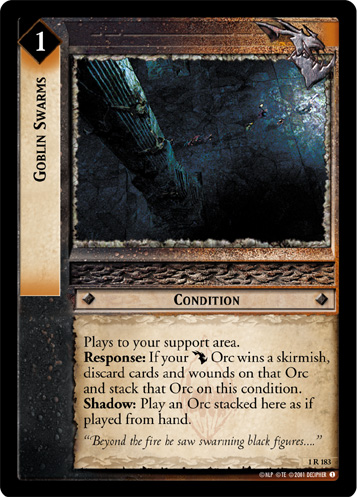 or Web (8C30)
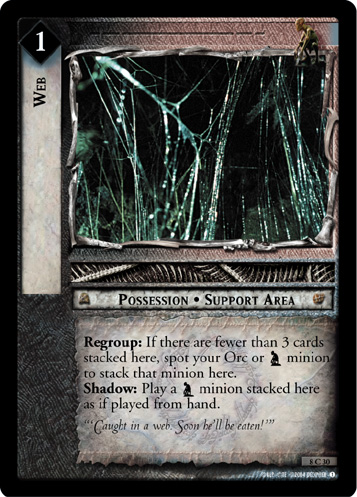 , but it can be another card entirely, like Sindri, Dwarven Lord (9R10)
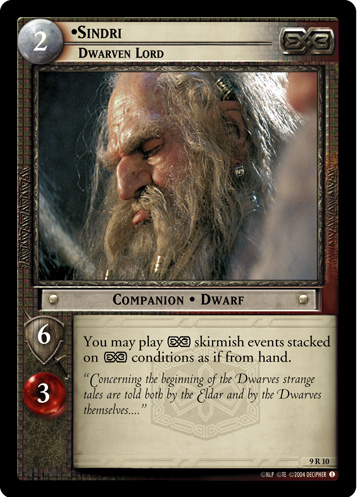 . Some cards can even play themselves from a stacked state, like Slaked Thirsts (7U14)
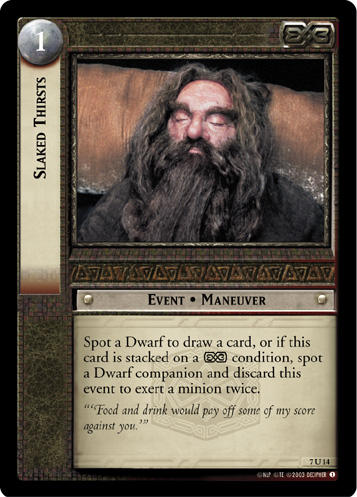 , or have game text that is usable while they are stacked on another card, like Isengard Tender (6U70)
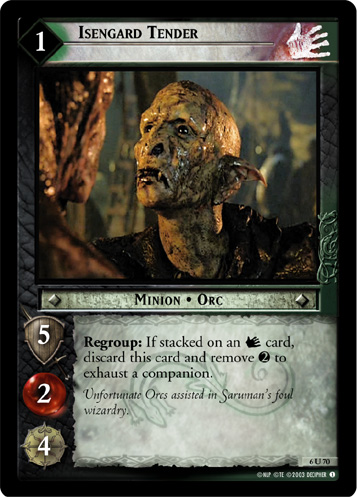 . If a card with other cards stacked on it leaves play for any reason, all of the cards stacked on that card are discarded. Likewise, if a controlled site with cards stacked on it is liberated, all of those stacked cards are discarded.
The Lord of the Rings TCG does not have a "stack" the way Magic: the Gathering does. For complex interactions where cards respond to and interrupt each other, see the Current Rulings Document.
Rules Entries
Stacking a card is not playing a card. Stacked cards are placed face up and may be looked at by any player at any time. Stacked cards are not in play and are not active. You cannot spot them. They do not count for uniqueness. A stacked unique card may be in play elsewhere. Multiple copies of the same unique card may be stacked together.
- stack section
When a card (other than a site) leaves play for any reason, any cards played on that card (or borne by or stacked on that card) are discarded.
- leaving play section
When you liberate a site, place it back on the adventure path. Any cards on that site are discarded.
- liberate section

